Today I had my first treatment for the iron overload I mentioned in my last post (back in January). The procedure is called venesection. They just take a pint of blood, and throw it away! It is quite shocking really (well, mildly shocking anyway). The blood flows into a bag, and the bag is thrown in the bin!
I have arranged to have the treatment at my local hospital, rather than going to UCH in London. The hospital building dates from the '60s, and is no longer "viable" (whatever that means) - they are going to tear it down soon. The contrast between this hospital and the brand new cancer center at UCH is quite stark. However, the nurses were very efficient and friendly, so the procedure was very pleasant (even though the needle to extract this much blood was much larger than for a blood test sample).
I attended the BMT clinic at the end of April, but the visit was unremarkable so I did not post an entry here. I am attending this clinic every three months, and I expect this to extend to six months or yearly very soon. My next milestone is my second birthday (June 23rd).
Wednesday, 8 May 2013

Thursday, 31 January 2013
A royal clinic!
Today I shook hands and chatted with Prince Charles and Camilla!
When I arrived at the clinic, the nurses told me that there would be a royal visit, but I thought it would be in the afternoon and I would miss it. But first let me record the interesting medical bits, and then I will return to the prince ...
There is too much iron in my body. It has no short term effects, but can cause organ failure in later life. You can read about it at Wikipedia (and of course other places if you care to), in my case it is caused by the large number of blood transfusions I had whilst being treated (both in hospital and shortly after transplant). The red cells from a transfusion last a lot less time than normally produced ones, and as they breakdown they leave iron behind (which builds up). The treatment is quite simple - they just remove a unit of blood periodically! Over time the excess iron is thinned out, and the life cycle of my newly produced red cells evens out the iron concentration. The frequency of treatment is up to me! They recommend once a month, but I can have the blood removed more frequently if I can take it. My doctor says that at once a month it will take 9+ months. I hope I can get this done at my local hospital rather than going up to UCH each time - we shall see. Sadly, the blood will just be thrown away - the blood bank is not interested in blood from my transplanted stem cells.
I am going to stop taking aciclovir, which is an anti-viral drug I have been taking twice daily since transplant. I have been taking it because I have had shingles (Herpes Zosta) which can happen after getting chicken pox as a child. The virus lies dormant, normally kept at bay by ones immune system. I have been taking the antiviral to keep it in check whilst my own immune system recovers. Once I stop taking the aciclovir, it is likely I will get shingles (after one month and within 6 months). When I get it, I will be treated with antivirals, and afterwards my own immune system will keep it under control ... that is the theory anyway! I cannot take the drug for the rest of my life, so I am happy to stop and see what happens. I just hope it does not strike in a bad place (like the eye, as happened to a colleague of mine). When I got it before it was in the back of my neck.
So, what of the royals? I was waiting for the pharmacy to fill my prescription when they told us all that the prince would soon be arriving. My nurses came down to the lobby and we waited eagerly, hoping he would come and say hello. The royal couple duly arrived, but went to the other side of the lobby! So the three of us crossed the room and made ourselves as prominent as we could. Sure enough they shook our hands (the nurses curtsied rather prettily whilst shaking hands; I did not bow) and asked some questions. A very exciting episode even for a dyed-in-the wool cynic like me!
And I must just say, I call them "my nurses", but these ladies are actually "clinical nursing specialists", and very well educated and knowledgeable in their field (as well as being charming).
When I arrived at the clinic, the nurses told me that there would be a royal visit, but I thought it would be in the afternoon and I would miss it. But first let me record the interesting medical bits, and then I will return to the prince ...
There is too much iron in my body. It has no short term effects, but can cause organ failure in later life. You can read about it at Wikipedia (and of course other places if you care to), in my case it is caused by the large number of blood transfusions I had whilst being treated (both in hospital and shortly after transplant). The red cells from a transfusion last a lot less time than normally produced ones, and as they breakdown they leave iron behind (which builds up). The treatment is quite simple - they just remove a unit of blood periodically! Over time the excess iron is thinned out, and the life cycle of my newly produced red cells evens out the iron concentration. The frequency of treatment is up to me! They recommend once a month, but I can have the blood removed more frequently if I can take it. My doctor says that at once a month it will take 9+ months. I hope I can get this done at my local hospital rather than going up to UCH each time - we shall see. Sadly, the blood will just be thrown away - the blood bank is not interested in blood from my transplanted stem cells.
I am going to stop taking aciclovir, which is an anti-viral drug I have been taking twice daily since transplant. I have been taking it because I have had shingles (Herpes Zosta) which can happen after getting chicken pox as a child. The virus lies dormant, normally kept at bay by ones immune system. I have been taking the antiviral to keep it in check whilst my own immune system recovers. Once I stop taking the aciclovir, it is likely I will get shingles (after one month and within 6 months). When I get it, I will be treated with antivirals, and afterwards my own immune system will keep it under control ... that is the theory anyway! I cannot take the drug for the rest of my life, so I am happy to stop and see what happens. I just hope it does not strike in a bad place (like the eye, as happened to a colleague of mine). When I got it before it was in the back of my neck.
So, what of the royals? I was waiting for the pharmacy to fill my prescription when they told us all that the prince would soon be arriving. My nurses came down to the lobby and we waited eagerly, hoping he would come and say hello. The royal couple duly arrived, but went to the other side of the lobby! So the three of us crossed the room and made ourselves as prominent as we could. Sure enough they shook our hands (the nurses curtsied rather prettily whilst shaking hands; I did not bow) and asked some questions. A very exciting episode even for a dyed-in-the wool cynic like me!
And I must just say, I call them "my nurses", but these ladies are actually "clinical nursing specialists", and very well educated and knowledgeable in their field (as well as being charming).
Monday, 24 December 2012
A Christmas present from the hospital
Although I wrote in early December that it would probably be my last post of 2012, this is my second post since, but I received some good news this morning that must be recorded here.
The hospital rang to say that the results of the additional chimerism test they did on the 6th have arrived ... and I am now 100% donor. None of my original immune system remains, as far as the tests can show, meaning that the last few of my original T-cells that showed up three weeks ago have been killed! I have been waiting for this day for a year, pretty much since they did the second chimerism test and decided I needed treatment with mature lymphocytes from my brother.
It means that the transplant has been as successful as it could be. It is as close to a cure that I can get, and it is the perfect Christmas present.
I would like to say a very special thank you to Harry, to all the staff at UCH, and to all of you for your support. Happy Christmas!
The hospital rang to say that the results of the additional chimerism test they did on the 6th have arrived ... and I am now 100% donor. None of my original immune system remains, as far as the tests can show, meaning that the last few of my original T-cells that showed up three weeks ago have been killed! I have been waiting for this day for a year, pretty much since they did the second chimerism test and decided I needed treatment with mature lymphocytes from my brother.
It means that the transplant has been as successful as it could be. It is as close to a cure that I can get, and it is the perfect Christmas present.
I would like to say a very special thank you to Harry, to all the staff at UCH, and to all of you for your support. Happy Christmas!
Wednesday, 19 December 2012
Immunisation
Today is a milestone on my journey - I have begun my immunisation program.
I remember very clearly during the week before my transplant the doctor telling me all about it, and what will happen. He told me that after the transplant I would have the immune system of a baby, and 18 months after the transplant I would be given all of the normal infant vaccines. I remember thinking that 18 months was a lifetime away ...
... and the day has arrived! Today I got 3 jabs (diphtheria, polio, tetanus, and a few others). Some require repeated doses, over the next 3 months. They do not give me MMR ("live" vaccines are contraindicated).
I remember very clearly during the week before my transplant the doctor telling me all about it, and what will happen. He told me that after the transplant I would have the immune system of a baby, and 18 months after the transplant I would be given all of the normal infant vaccines. I remember thinking that 18 months was a lifetime away ...
... and the day has arrived! Today I got 3 jabs (diphtheria, polio, tetanus, and a few others). Some require repeated doses, over the next 3 months. They do not give me MMR ("live" vaccines are contraindicated).
Thursday, 6 December 2012
Host T-cells refuse to die!
The results from last chimerism test show that there is still a small residual level of my original host T-cells (white blood cells). Today at the clinic they took blood for a repeat test, in the hope that the previous DLI (donor lymphocyte infusion) is still working, and these last few blighters will be killed off.
As I have remarked before, the chimerism test is only accurate to a certain level, so even if the test is negative it does not mean that I have no residual T-cells, just that the test cannot detect them - in the case of a negative test there is some uncertainty. However, since the test is showing a small positive, there is absolute certainty that I still have some host T-cells, and so they will treat me with another DLI in the new year if this latest test still shows positive. The only risk of another DLI is that I will get GVH (graft-versus-host disease), but since I have had hardly any from the previous treatments, it is unlikely that I will get bad GVH from another treatment, given that the cells are all from the same batch taken from my brother last February (deep frozen).
As I wrote last time, I will now start a series of vaccinations and boosters similar to the ones given to children. Interestingly, this does not include MMR, which they do not give to adults on the grounds that the chance of getting any of them is low, and the possible risks are not worth it.
In the hospital, someone has been watching too much Star Trek, and all the nurses now have colour-coded uniforms! Sadly, not quite as bold as the Trekkie oranges, reds and blues, but limited to piping around the sleeves and collars of their blue jackets.
I suspect this will be my last post of 2012, so I wish you all seasons greetings, and a healthy new year.
As I have remarked before, the chimerism test is only accurate to a certain level, so even if the test is negative it does not mean that I have no residual T-cells, just that the test cannot detect them - in the case of a negative test there is some uncertainty. However, since the test is showing a small positive, there is absolute certainty that I still have some host T-cells, and so they will treat me with another DLI in the new year if this latest test still shows positive. The only risk of another DLI is that I will get GVH (graft-versus-host disease), but since I have had hardly any from the previous treatments, it is unlikely that I will get bad GVH from another treatment, given that the cells are all from the same batch taken from my brother last February (deep frozen).
As I wrote last time, I will now start a series of vaccinations and boosters similar to the ones given to children. Interestingly, this does not include MMR, which they do not give to adults on the grounds that the chance of getting any of them is low, and the possible risks are not worth it.
In the hospital, someone has been watching too much Star Trek, and all the nurses now have colour-coded uniforms! Sadly, not quite as bold as the Trekkie oranges, reds and blues, but limited to piping around the sleeves and collars of their blue jackets.
I suspect this will be my last post of 2012, so I wish you all seasons greetings, and a healthy new year.
Saturday, 27 October 2012
New arrivals
At the clinic on Thursday they took blood for the next chimerism test (it is three months since I had the last DLI). There is an interesting article here about mixed chimerism and relapse rates if you can stomach the medical grammar! I will get the results in a couple of weeks, and I very much hope they show that no more of my original cells remain, as it will mean that my treatment is more or less complete. They also took enough blood for a BCR-ABL test (the test for cancerous cells) - again the results are available in a couple of weeks (I will write a post when I get them).
They have reduced the frequency of my visits to once every six weeks, in what I hope will be a continuing trend that eventually settles to once a year. The next major milestone for me is my vaccinations. I have the immune system of a baby. and so I will need all the common vaccinations, which they administer 18 months post transplant (so in December or January).
On the home front, we have new arrivals:

They have reduced the frequency of my visits to once every six weeks, in what I hope will be a continuing trend that eventually settles to once a year. The next major milestone for me is my vaccinations. I have the immune system of a baby. and so I will need all the common vaccinations, which they administer 18 months post transplant (so in December or January).
On the home front, we have new arrivals:

Their names are Kali (on the left) and Bella (on the right), and are just 4 months old. I know, they are impossibly cute in repose:) - but they can be very naughty!
Sunday, 23 September 2012
Doing the Bridgathon
Today was the Bridgathon. The weather forecast was for wind and rain, so we donned our waterproofs and headed off to London in the car. In the backpack we had cheese rolls, water and rather optimistically an umbrella (it proved to be far too windy to use it).
We arrived at the meeting place on time, and got our tee-shirts. For maximum publicity we wore these over the top of our coats. Here we are at the start, still dry!

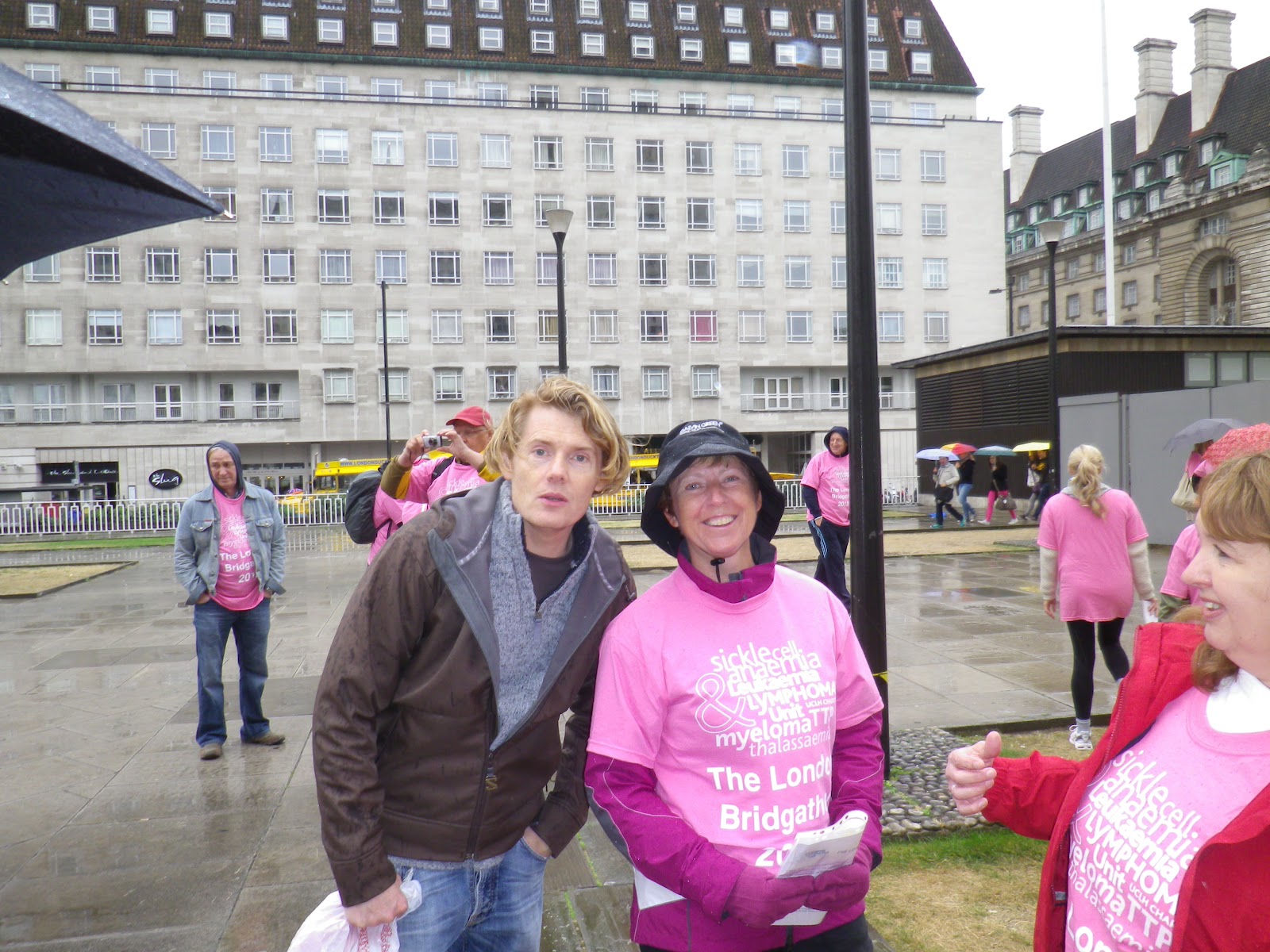
The walk was officially started by the charity's patron Julian Rhind-Tutt, a British TV actor. Here he is with Rose:

Julian told us that in a few days time it would be 20 years since he had his bone marrow transplant!
The walk started at the London Eye, and we set off toward Westminster bridge with the Houses of Parliament looking rather grand as the backdrop:


We arrived at the meeting place on time, and got our tee-shirts. For maximum publicity we wore these over the top of our coats. Here we are at the start, still dry!

The walk was officially started by the charity's patron Julian Rhind-Tutt, a British TV actor. Here he is with Rose:
Julian told us that in a few days time it would be 20 years since he had his bone marrow transplant!
The walk started at the London Eye, and we set off toward Westminster bridge with the Houses of Parliament looking rather grand as the backdrop:

We then crossed Westminster bridge, and continued walking along the riverside and crossing various bridges along the way. The walk passes lots of great landmarks along the Thames, but sadly the weather forecast was very accurate, and it got wetter and windier as the walk wore on, which made it harder to enjoy them. Here we are in front of the Golden Hind

We crossed over London's famous Tower Bridge at the furthest point of the walk, and by a coincidence it was raised to let a rather tall masted ship pass through.

We had our cheese rolls whilst waiting for the bridge to be reopened (just a few minutes), and then headed on towards the finish. The weather had become really bad by now - driving rain and wind - although there were still a decent number of tourists out and about!
As we were walking around, I did feel very proud of London, surely the greatest city on Earth. Nowehere else can you find such a fabulous mix of history, culture and stunning archictecture, both old and new. Here is the brand new London Shard:

We finally arrived at the finish after two and a quarter hours, tired and rather wet.

I also seem to have picked up a rather painful blister! The walk was just over 7 miles, and over 200 people took part, so despite the weather I think the day was a success. This is the route that we took:

Many thanks again to all of you who donated.
Subscribe to:
Posts (Atom)